 Skip to content
You sit down for a GCSE Maths past paper. The clock ticks. You know the topics, but time slips away. How to get faster at GCSE Maths becomes the burning question for Year 10 and 11 students facing Higher tier or Foundation tier papers. This guide cuts through the rush. It shows you practical steps to improve speed and accuracy GCSE Maths. No shortcuts. Just methods that work.
Why GCSE Maths Feels Rushed
GCSE Maths papers test more than knowledge. They demand GCSE Maths exam technique under pressure. You run out of time on long questions. Panic sets in. You blank on familiar topics. Careless errors creep into simple sums.
It’s common. You look at the question, and your brain goes blank. Slow methods eat minutes. Messy working leads to lost marks. The good news? This is fixable. With GCSE Maths time management, you build speed without sacrificing accuracy. Clarity comes from practice. You gain control.
The Real Reason You’re Slow (3 Causes)
Methods not automatic yet slow you down. You pause to recall steps for quadratic equations or trigonometry. This hesitation builds.
Fix: Drill core methods daily. Pick 10 questions per topic from GCSE Maths past papers. Time yourself at double speed. Repeat until fluent.
Getting stuck too long kills momentum. One tough question halts the paper. You spiral.
Fix: Set a 2-minute timer per question. Move on if unsolved. Return later. This trains your brain to stay calm.
Messy working leads to mistakes. Scribbles hide errors. You lose track.
Fix: Use lined paper. Write one step per line. Box your final answer. Clear layout grabs method marks.
The Speed + Accuracy System
Build speed with a simple loop. Every week, do a timed set of 20 questions from GCSE Maths past papers. Match your exam board. Aim for real conditions: 1 mark per minute. Mark against the GCSE Maths mark scheme right away. Spot patterns in errors.
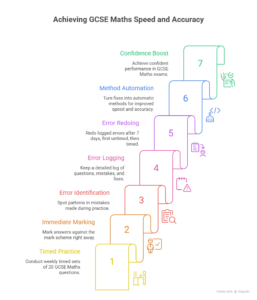
Keep an error log. Note question, mistake, and fix. Example:
“Q12: Algebra – sign error – fix: rewrite steps slowly.”
“Q5: Fractions – forgot simplify – fix: always check at end.”
“Q18: Geometry – wrong formula – fix: memorise top 5.”
Redo logged errors after 7 days. Untimed first, then timed. This loop embeds fixes. Methods turn automatic. Speed rises. Accuracy follows. If you only do one thing, stick to this system. It transforms rushed attempts into confident papers.
Take Sarah, a Year 11 student on Foundation tier. She timed sets weekly but lost marks to sloppy working. After two loops with her error log, she finished papers 10 minutes early. Her mock score jumped from grade 4 to 6. Steady wins.
GCSE Maths Timing Rules That Save Marks
Follow these rules in every practice. They build GCSE Maths time management muscle.
One mark equals one minute. A 5-mark question gets 5 minutes max. Scan the paper first. Tally total marks. Divide by 90 for pacing.
Use the 2-minute stuck rule. Read the question. Try for 2 minutes. No progress? Skip with a mark. Return at end. This saves time for easy wins.
Skip and return smartly. Flag multi-step questions early. Nail quick ones first. Builds momentum.
Last 5 minutes: Checklist time. Scan skipped questions. Add any working. Bubble answers. No time for perfection. Done is better.
How to Gain Marks Even When the Final Answer Is Wrong
GCSE Maths mark schemes reward working, not just answers. Examiners give method marks for correct steps, even if the end result slips. Show every line clearly. This grabs 60-80% of marks on tough questions.
Write neatly. One operation per line. Label steps: “Expand: (x+2)(x+3) = x² + 5x + 6”. Circle intermediates. Check units and rounding as specified.
Mini-example 1 (Higher tier probability): Question: Probability of drawing red then blue without replacement from 3 red, 2 blue.
Your working: Total=5. P(red)=3/5. Then 1 red left, total=4, P(blue)=2/4=1/2. Multiply: 3/5 × 1/2 = 3/10. (Wrong? No—method scores full steps.)
Mini-example 2 (Foundation tier percentages): Question: 20% of 250, round to nearest 10.
Your working: 10% of 250=25, so 20%=50. (If you wrote 45 by error, steps earn most marks. Note: “Round to nearest 10: 50.”)
Explore GCSE Maths Tutoring
Boost GCSE Maths grades with structured tutoring focused on key topics, past-paper practice, and exam methods to improve accuracy, speed, and method marks (Foundation & Higher).
A Simple 7-Day Plan to Get Faster
This plan fits busy schedules. 20-30 minutes most days. Works for Higher tier GCSE Maths (aiming grade 6 to 8/9) or Foundation tier (grade 4 to 6 GCSE Maths). Higher tier needs deeper methods; Foundation focuses fluency on basics. Adapt papers accordingly.
Day 1: Timed 20 questions (non-calculator style). Mark with scheme. Log 3 errors.
Day 2: Redo Day 1 errors untimed. Note fixes.
Day 3: 15 timed questions (calculator paper GCSE Maths). Mark and log.
Day 4: Rest or light review of logs.
Day 5: Redo all week’s errors timed.
Day 6: Full 40-mark mini-paper timed. Mark fully.
Day 7: Review logs. Plan next week’s topics.
Repeat. Tweak for your exam board. Progress builds fast.
The Most Common GCSE Maths Mistakes
Mistake: Sign errors in algebra.
Fix: Rewrite each step slowly before moving.
Mistake: Forgetting to simplify fractions.
Fix: Circle answer, check if reducible.
Mistake: Wrong order of operations.
Fix: Tattoo BIDMAS on your hand for exams.
Mistake: Units mismatch (e.g., cm to m).
Fix: Underline given units, match output.
Mistake: Rounding too early.
Fix: Carry extra decimal till end.
Mistake: Pyramid mistakes in expansions.
Fix: Write terms vertically, add column by column.
Mistake: Inverse wrong on trig.
Fix: SOHCAHTOA flashcard daily.
Mistake: Probability tree miscounts.
Fix: Total branches =1 each stage.
Mistake: Bearing direction slip.
Fix: Clockwise from north rule.
Mistake: Quadratic factor sign flip.
Fix: Check product and sum match.
Frequently
Asked Questions
Time past papers strictly. Use the 1 mark=1 minute rule. Log errors weekly and redo them. Focus on automatic methods for algebra and geometry. In a month, you'll finish 10-15 minutes early without rushing. Practice beats talent here.
Slow down on working out. Write one step per line. Box answers. Use estimation checks: does 15% of 200 feel like 30? Yes. Review your error log daily. Most "silly" errors are habits—replace them with checklists.
Both, in sequence. Untimed builds methods. Timed builds speed. Start 50/50, shift to 80% timed by Easter. Always mark with schemes. This mirrors GCSE exams perfectly.
Year 11: 1 full paper weekly from October. Year 10: half-papers twice weekly. Your exam board's site has free GCSE Maths past papers. Quality over quantity—mark and log every one.
Target Foundation tier weaknesses: fractions, percentages, ratios. Timed drills on 20 questions daily. Redo errors. Gain method marks with clear steps. Mock scores rise fast with consistency.
Practice the 2-minute stuck rule. Skip, return. End with 5-minute checklist. Estimation verifies calculator work. Weekly loops make methods stick. Accuracy follows speed when trained together.
Light review: skim error log, top formulas. No new papers. Pack calculator (batteries fresh), ID, pencils. Sleep by 10pm. Eat breakfast with protein. Walk in calm—you're ready.
Yes. Higher tier adds complexity like quadratics and trig proofs. Same system: timed sets from Higher papers. Focus logs on method depth. Students hit grade 6 to 8/9 with weekly practice.
