 Skip to content
If you are searching when are GCSE exams 2026, you probably want the dates quickly and a clear plan so revision does not turn into last-minute panic. This page gives you the GCSE exam dates 2026 window, explains how the GCSE timetable 2026 works, and shows what to do next.
Key GCSE exam dates 2026 (save these)
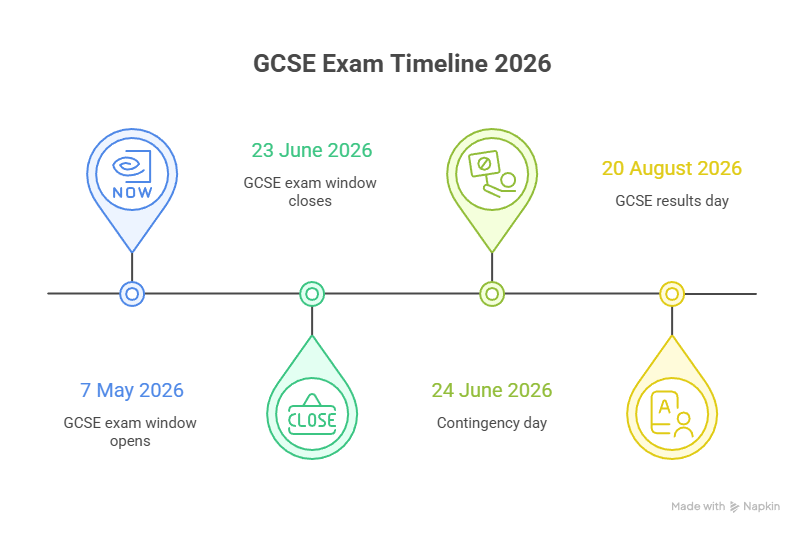
Your school or exam centre will issue a personal GCSE exam timetable 2026 with the exact paper dates for your child.
What you should do right now (2-minute checklist)
This is the part most families delay and regret later.
Ask the school: “When will we receive the personal GCSE timetable?”
Put results day and contingency day in your calendar today
Pick three priority subjects (usually Maths, English and Science)
Start one timed practice session each week, even 20 minutes helps
If mock grades are stuck, change the method instead of adding more hours
GCSE exam dates 2026 explained in plain English
What the exam window means
The exam window is the national period when most written GCSE papers take place. Students will not have exams every day. Papers are spread across the window depending on subject and exam board.
What the contingency day means
A contingency day is a national backup day. It is used only if there is major disruption. It is rare, but students should keep the day available until the school confirms exams are fully finished.
What results day means
Results day is when students receive grades and confirm sixth form or college places. If something does not look right, there are post-results options such as a review of marking or access to scripts.
How the GCSE timetable 2026 works
GCSE timetables follow a simple chain. Your personal timetable is built from a national framework, then your centre confirms the final details.
- 1
JCQ publishes the common timetable framework.
- 2
Exam boards place their papers within that framework.
- 3
Your school or exam centre issues the personal timetable with exact dates and times.
Which exam boards matter?
Boards differ by nation, so small timetable differences are normal.
England
AQA, Pearson Edexcel, OCR (regulated by Ofqual)
Wales
WJEC and Eduqas
Northern Ireland
CCEA
This is why searches like GCSE exam dates 2026 England, GCSE exam dates 2026 Wales and GCSE exam dates 2026 Northern Ireland can show small differences.
What time do GCSE exams start?
Most centres run two sessions. Always follow the times on your personal timetable.
Morning exams
Around 9:00am
Typical start time (confirm with your centre)
Afternoon exams
Around 1:30pm
Typical start time (confirm with your centre)
Timetable checks that prevent easy mistakes
- Paper code and paper title
- Tier (Foundation or Higher where relevant)
- Calculator or non-calculator papers
- Room and start time
- Any clashes and the instructions from your centre
If something looks wrong, fix it early. Sorting it on the day is stressful and sometimes impossible.
Private candidate? Read this first
If you are a private candidate, you must register through an approved exam centre. Do not leave this late because centres may stop accepting candidates early.
Private candidate checklist:
Find an exam centre that accepts your subjects and exam board
Confirm entry deadlines, fees and late fees
Ask how you will collect results in August
Confirm ID requirements and exam day rules
Key deadlines that matter for families
For most students (school-managed)
Schools handle entries and admin. What matters to you is getting the personal timetable and planning revision around the May to June window.
For private candidates (you manage it)
You are responsible for the exam centre booking, entries, payment, and any subject requirements, including NEA arrangements where relevant.
Quick advice: if you are a private candidate, availability is often the main issue. Contact exam centres early.
3-month GCSE revision plan (two options)
3-Month GCSE Revision Plan (two options)
Pick the option that matches your reality. The goal is simple: consistent practice that turns revision into marks.
Weeks 1 to 4: Build the base
- Active recall (flashcards or blurting)
- Short exam questions by topic
Weeks 5 to 8: Turn revision into marks
- One timed question set per subject each week
- Mark it the same day
- Keep a simple mistake list (why you lost marks)
Weeks 9 to 12: Exam mode
- Full timed papers for key subjects
- Fix the top three repeating weaknesses
- Redo weak question types after 7 days
Daily structure (minimum)
- 25 minutes on the weakest topic
- 20 minutes on exam questions
- 10 minutes marking and fixing one mistake
What happens on exam day (checklist and timing tips)
What to bring
Pack the night before. A small miss can throw confidence off.
- Pens, pencil and ruler
- Calculator (if allowed for that paper)
- Clear water bottle
- Any approved access arrangements (as told by the centre)
Timing habits that stop last-page panic
These habits protect marks even when a paper feels harder than expected.
Scan the paper quickly and start with easier marks to build momentum.
Do not spend 10 minutes on a 2-mark question. Move on and come back later.
In the last 5 minutes, check units, negatives, rounding and unanswered parts.
If your child is ill or late
Act fast. The centre decides what is possible and what evidence is needed.
Coursework (NEA) and Practicals: What Still Counts
Not everything happens in the exam hall. Some subjects include Non-Exam Assessment (NEA). Science practical work is done in class, and knowledge from required practicals can appear in written papers.
Main point: NEA deadlines can steal revision time. Get them finished early so exam prep doesn’t collapse.
Frequently
Asked Questions
Most written GCSE exams start within the summer exam window beginning 7 May 2026, but exact paper dates depend on your board and timetable.
The GCSE summer window runs up to 23 June 2026. Students should also keep 24 June free as the contingency day.
Thursday 20 August 2026.
Most centres use 9:00am and 1:30pm sessions.
GCSE papers are scheduled on weekdays within the exam window. Your timetable is the final reference.
Backup days used only for national disruption. Students must remain available until the centre confirms exams are finished.
Your school/exam centre provides your personal timetable. JCQ and exam boards publish the wider timetable framework.
Consistency wins: timed practice + marking + fixing mistakes beats long sessions that lead to burnout.
